
Applied analytics enhanced with AI
Learn from industry-leading innovators
Unrivalled access to the best minds in business analytics
- Online Study
- Start: Jan, Mar, May, Jul, Aug, Oct
- 24 months
- $5,496 per subject (2027)
- MC-APBUSA
Why study a Master of Applied Business Analytics online with Melbourne Business School?
- Master analytics across business functions, with electives in supply chain, marketing, investment or select subjects from the MBS online MBA
- Become a sought-after analytics expert with technical skills to reduce bias, uncover insights and drive business impact
- Apply core analytics concepts to solve business problems and guide responsible use of AI-based analytical techniques
- Harness machine learning and forecasting techniques to mitigate business risks.

Is the Master of Applied Analytics right for you?
Whether you're an experienced analytics professional or ready to make a career move, this program provides you with technical and strategic capability to use data and AI to inform business decisions.
- You have a qualification in commerce, mathematics, physics, computer science, information systems, engineering or science
- Motivated to strengthen your technical skills and explore more advanced analytics concepts
- Seeking a qualification that signals genuine depth of expertise to employers
- Wanting to build and learn from a network of like-minded peers, professionals and industry experts
- Looking to obtain and apply in-demand skills to drive change in your career, without compromising personal commitments.
Recognise yourself here? Find out if you meet the entry requirements.
- With a degree in another discipline, but you recognise the value of analytics and want to build foundational skills to transition into the field
- Curious about how data and AI can improve business decisions and wanting formal training to understand the fundamentals
- Looking to build credibility for a move into a more analytical or technical position
- Wanting practical, hands-on learning you can apply from day one.
If these points sound more like you, the Graduate Certificate in Applied Business Analytics could be your next step.
What you will study
The Master of Applied Business Analytics is designed to progressively build your skills from foundational to advanced.
Hands-on application and AI-enhanced analytics are embedded throughout your learning to give you the confidence and capability to hit the ground running.
You will complete 11 subjects, including:
- Eight core subjects
- Two stream subjects
- One double-weighted capstone subject.
You will start your masters in the Flex Stream. As the program grows, additional streams will be added to match student and industry demand.
Complete all core subjects.
Foundations of Data Analytics
In today’s data-driven world, a strong understanding of mathematics, probability and statistics is essential for making informed business decisions. This subject introduces you to these foundational concepts, blending theory with practical exercises to build confidence and prepare you for advanced analytics topics.
Analytics for Business Decisions
Smart business decisions don’t come easy. But they’re what separate thriving businesses from the rest. This subject equips you with tools to navigate complex business environments, mitigate cognitive biases and make better decisions through structured models and evidence-based approaches.
Data Visualisation for Analytics
Data visualisation transforms complex datasets into powerful and compelling stories. In this subject, you will master the art and science of visual storytelling by using industry-standard tools to communicate insights effectively.
AI and Ethics in Analytics
Artificial Intelligence (AI) is reshaping business analytics, but its use comes with ethical responsibilities. This subject reviews key AI concepts (such as machine learning, neural networks and predictive analytics) alongside key ethical frameworks, preparing you to implement AI responsibly in business contexts.
Data Platforms for Analytics
In a tech-driven world, effective decision-making is shaped by reliable data. This subject teaches you how to design and implement data warehouses that power business insights, with a focus on cloud computing, data curation and CRM-oriented systems.
Programming for Analytics
In this subject you will discover the essentials of programming. Using an intuitive high-level language, you’ll learn about variables, conditionals, functions, loops and how to design simple algorithms. Topics will be brought to life through practical, real-world examples, helping you build confidence even if you’re completely new to programming.
Modelling and Predictive Analytics
Statistical modelling and prediction are used across many areas, from marketing and finance to human resources. This subject gives you the foundational skills to make sense of complex data and use it to support smart business decisions. Through real-world case studies and industry examples, you’ll learn a range of techniques, such as traditional regression, time-series analysis, multivariate models and contemporary approaches that use historical data.
Advanced Business Analytics: Machine Learning
With growth of data online, there’s an essential need for businesses to find patterns and make sense of new information quickly. Machine learning gives us tools to do this automatically, helping us understand processes better and even predict future outcomes. In this subject, you’ll get introduced to key techniques like neural networks, support-vector machines, clustering and ensemble methods such as bagging, boosting and random forests. You’ll also get hands-on experience applying and evaluating these tools in real-world business scenarios.
Select two subjects from the list below.
Finance
This subject addresses the foundations of valuation and financial management. Concepts addressed are relevant for a variety of organisations, as well as for personal financial planning and investments.
Marketing
To be successful, organisations need to recognise, create, grow and protect market-based assets that influence demand. This subject focuses on the challenges organisations face in managing demand and how to address those challenges with optimal demand-side strategies.
Operations
In fiercely competitive global and dynamic environments, organisations face increasing pressures to exceed stakeholder expectations across measures such as sustainability, social responsibility, cost, quality, flexibility and innovativeness. This subject addresses the analysis, design, management and continuous improvement of business processes. It covers core operations concepts essential for leveraging an organisation’s capabilities to achieve sustainable competitive advantage.
Managing People
Effective management of individuals, teams and organisations requires an understanding of human behaviour. This subject examines human behaviour at the individual, group and organisational levels through a business lens. This subject assists students to better manage themselves, and better manage and lead other people, groups and organisations.
Managerial Economics
Economics is relevant to everything an organisation does, from its operations and performance to its interactions with stakeholders and society more broadly. This subject addresses fundamental economic concepts and analytical skills, providing students with the tools of economic reasoning necessary for developing and evaluating strategic business options and making better decisions.
Leading Sustainability with Data and AI
This subject emphasises an evidence-based perspective by applying data analytics and artificial intelligence tools to improve decision-making on sustainability issues. You will gain a better understanding of how data analytics and AI can shed light on sustainability challenges.
Strategic Pricing and Business Insights
On-campus only, Pre-requisite: Marketing
Better understand the pricing process and design effective pricing strategies. It will cover the fundamental theories, conceptual frameworks, and analytical tools for formulating pricing strategies. You will gain insights into successful pricing strategies in various industries and know how to improve a firm’s pricing decision through price customisation and price structure.
Human Resource Analytics
On-campus only, Pre-requisite: Managing People
Gain quantitative and qualitative analytical skills necessary to analyse HR data effectively to inform decisions in human resource management. You will also explore the integration of cutting-edge technologies, such as artificial intelligence (AI) and machine learning, in various HR and people management areas, including recruitment, professional development, performance evaluation, compensation, and succession planning.
Gen AI for Business
On-campus only
Run by leading academics and industry experts, the program covers the innovative applications of generative AI that can drive strategic growth and maintain a competitive advantage. This program can be customised to suit your organisation, ensuring long-lasting change, engagement and impact.
Please note: For Flex stream electives, you may choose any subject available at that point in time from the subjects listed. Electives may be subject to change.
Complete both subjects.
Finance
This subject addresses the foundations of valuation and financial management. Concepts addressed are relevant for a variety of organisations, as well as for personal financial planning and investments.
Applied Investment Analytics
Effective risk management is critical for organisational resilience. This subject equips you with the analytical tools and techniques to identify, assess and manage financial risk using real-world data and contemporary analytics methods.
This stream is planned for future intakes, subject to approval and availability.
Complete both subjects.
Marketing
To be successful, organisations need to recognise, create, grow and protect market-based assets that influence demand. This subject focuses on the challenges organisations face in managing demand and how to address those challenges with optimal demand-side strategies.
Applied Marketing Analytics
This subject gives you hands-on experience with marketing analytics, using technology and data to make smarter business decisions. Through real-world case studies and practical exercises, you’ll develop the skills to analyse customer and market data, solve complex marketing challenges and influence key outcomes like customer satisfaction, brand loyalty and word-of-mouth referrals.
This stream is planned for future intakes, subject to approval and availability.
Complete both subjects.
Operations
In fiercely competitive global and dynamic environments, organisations face increasing pressures to exceed stakeholder expectations across measures such as sustainability, social responsibility, cost, quality, flexibility and innovativeness. This subject addresses the analysis, design, management and continuous improvement of business processes. It covers core operations concepts essential for leveraging an organisation’s capabilities to achieve sustainable competitive advantage.
Applied Supply Chain Analytics
Get ready to turn supply chain challenges into smart solutions. This subject gives you practical experience in using mathematical modelling and analytics to optimise logistics and supply chain operations. You’ll learn how to analyse and make decisions at strategic, tactical and operational levels by covering areas like inventory management, facility location and logistics planning.
This stream is planned for future intakes, subject to approval and availability.
You will complete one of the capstone subjects below.
To qualify for a capstone subject in a specific stream, you must complete the two relevant subjects in that stream.
Applied Business Analytics Project
This subject gives you hands-on experience in solving real business problems with practical analytics solutions through a collaborative group project.
Marketing Analytics Project
This subject gives you hands-on experience in solving real marketing business problems with practical analytics solutions through a collaborative team project.
Investment Analytics Project
In this capstone subject, you’ll work in teams to build an investment portfolio using a variety of analytics algorithms commonly used in the finance industry. You’ll gain hands-on experience applying real-world tools to analyse financial data, identify market patterns and make informed investment decisions.
You’ll explore algorithms such as:
- Fundamental analysis: Evaluate the underlying value of securities using financial and economic data.
- Technical analysis: Identify trends and patterns from market price and volume data that may indicate future price movements.
- Quantitative analysis: Use statistical models and machine learning to predict market movements.
- Arbitrage: Use price discrepancies between different markets or securities to generate profits.
- Trend following: Generate trading signals based on historical price trends.
- Mean reversion: Identify securities likely to return to historical price ranges.
- High-frequency trading: Execute rapid trades to take advantage of small market discrepancies.
- Sentiment analysis: Analyse news and social media to gauge investor and market sentiment.
- Portfolio optimisation: Use models to optimise the allocation of portfolio assets based on risk and return objectives.
Supply Chain Analytics Project
This subject gives you hands-on experience in modelling and implementing optimisation solutions through a collaborative team project.
The program launches with the Flex Stream. Additional streams of study are planned and will be introduced progressively, subject to approval and availability. To qualify for a capstone project in a specific stream, you must first complete the relevant subjects in that stream.
Access a world-leading and industry-connected faculty
Strengthen your career advantage through our network of over 100 industry partnerships.
Collaborate with subject matter experts
Each week you’ll workshop solutions to real business challenges. Resulting in an advanced analytical skillset that you can confidently apply in your current and future roles.
Institute for Digital Innovation and AI
Gain unrivalled access to leading organisations and strategic insights to help you stand out in a fast-paced field.
Career outcomes
In modern business, data is everywhere, yet the experts who can understand and leverage it through analytics are rare.
The online or blended Master of Applied Business Analytics provides you with those sought-after skills to drive evidence-based decisions using analytics and AI tools.

Complemented by your professional background and career objectives, this program supports progression into roles such as:
- Business Process Analyst
- Head of Customer Analytics
- Manager of Analytics
- Marketing Insights Manager
- Portfolio Manager
- Portfolio Risk Analyst
- Principal Financial Analyst
- Risk Manager
- Senior Business Analyst
- Senior Business Intelligence Analyst
- Senior Insights Analyst
- Senior Market Research Analyst
- Senior Risk Manager.
Tools you'll use
The program is grounded in the analytics tools and languages employers look for, so your skills are valued no matter your industry.
You don't need prior experience to get started. You'll progressively build confidence with these tools, learning how to apply them to business challenges throughout the program. You'll develop fluency in:
Python
One of the world's most widely used analytics languages, used to build programs, apply machine learning and automate workflows.
R
A powerful tool for statistical analysis and modelling. You’ll use R to run statistical analysis, build predictive models and uncover patterns in complex data.
SQL
The backbone of data management in business, used throughout the program to store, retrieve and manipulate data at scale.
Tableau
A data visualisation tool used to translate data into interactive insights, helping you explore trends and effectively communicate findings to support decision-making.
Please note, tools listed are indicative only and may vary by subject.
The Melbourne Business School Online experience
Studying online with Melbourne Business School gives you a flexible and immersive learning experience that adapts to your lifestyle and commitments.
Built for online, with the option of blended learning
Six intakes per year
Accessible for the ambitious
Fees & Requirements
To apply for the Melbourne Business School online Master of Applied Business Analytics, you must have:
- A university degree in any discipline and weighted average mark (WAM) of 65% in the Graduate Certificate in Applied Business Analytics, or
- A university degree and weighted average mark (WAM) of 65% in one of the related areas: commerce, mathematics, physics, computer science, information systems, engineering or science and
- Two years of documented full-time professional work experience
- Meet the University’s English Language requirements.
Documented evidence of meeting the accepted minimum scores within the previous 24 months may be required.
- IELTS Academic English: Minimum score of 7.0 overall (writing 6.5; speaking 6.5; reading 6.5; listening 6.5)
- TOEFL: Minimum score of 91 (writing 23; speaking 22; reading 19; listening 19)
- Pearson: Minimum score of 72 (writing 65; speaking 66; reading 64; listening 64)
- Cambridge C1 Advanced: Minimum score of 178 (writing 180; speaking 187; reading 168; listening 168)
- LanguageCert Academic: Minimum score of 73 (writing 71; speaking 76; reading 65; listening 62)
- Michigan English Test (MET): Minimum score of 62 (writing 64; speaking 53; reading 59; listening 59)
For more information on English language requirements, visit the University of Melbourne website.
$5,496 per subject*, a total of $65,952 for the program*.
FEE-HELP is available for this degree, providing eligible students the opportunity to start studying without paying tuition fees upfront. Instead, the Australian Government pays the amount directly to Melbourne Business School on your behalf. Repayments are then made through the tax system once your income reaches the minimum threshold. Voluntary repayments can also be paid to the ATO at any time.
*Fees listed are for calendar year 2027. Melbourne Business School Online reserve the right to adjust course fees annually.
Organisations need professionals who can make clear, evidence-based decisions in complex and uncertain environments. The Master of Applied Business Analytics develops these capabilities, equipping professionals from any background with practical skills in statistical analysis, predictive modelling, programming, machine learning, data visualisation, optimisation and business applications. With a strong focus on practical application, the program prepares you to apply analytics in real business contexts, building your capability to support evidence-based decisions and leverage emerging technologies such as AI. This applied degree is built for working professionals who want to move beyond buzzwords and ensure analytics delivers measurable impact.
Simon Holcombe
Academic Director, Master of Business Analytics & Master of Applied Business Analytics

Exceptional E-learning
Fuelled by our Signature Pedagogy, we present a best-in-class online business curriculum.
Community: Enter Australia's premier business network. Gain personal access to a select circle of peers, academic leaders, and industry experts.
Challenge: Expand strategic thinking across diverse contexts. Go beyond learning to excel, leaving a lasting impact in a complex world.
Expertise: Explore diverse ideas and opinions to enrich your knowledge base and professional brand.
Engagement: Embark on an immersive academic journey. Dive into tailored learning activities and real-world challenges.
Learn more about our exceptional online learning experience >
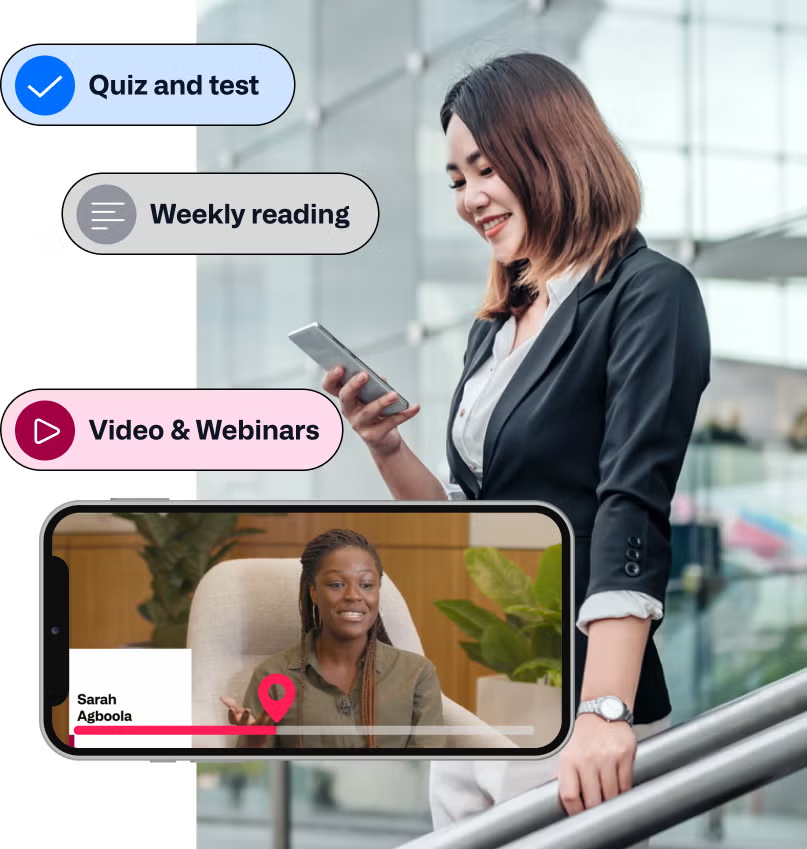
Join exceptional people
Achieve your potential as you learn alongside and from the best and brightest minds in business.
World-leading academics
Gain insights from Melbourne Business School’s exceptional educators, who bring a wealth of global experience across private, public, and not-for-profit sectors.
Global community
Build meaningful networks with like-minded professionals who can influence, inspire and be a valuable career resource for years to come.
Dedicated student support
From enrolment to graduation, our Student Success Advisers are here to help you succeed and make the most of your journey.
The Business Essentials for Managers program opened my eyes to new ideas and career paths. Grateful for online learning, pursuing my MBA goal, and building connections with peers.
Bethea Robertson,
Melbourne Business School online student

Growth-driven pursuit: Inspired by a simple quote, I seek an MBA to surround myself with like-minded individuals for future senior leadership.
Kaleb Roberts,
Melbourne Business School online student

Online learning suits my schedule, offering valuable interactions with staff and cohort, enhancing my learning experience through various online methods.
Lakshmi Chilamkurti,
Melbourne Business School online student

Pursuing an MBA for career advancement, gaining advanced skills, and personal growth. Motivated by professional development and transition to leadership roles.
Raveena Paul,
Melbourne Business School online student

Inspired by incredible lecturers, I appreciate the global perspective in the course, analysing top companies worldwide for a comprehensive learning experience.
Kebbie Kirkcaldie-Bowell,
Melbourne Business School online student

Related Degree Programs
Deliver greater impact in your current or future role by leveraging your learnings, giving you the confidence and tools needed to succeed in today's business landscape.

Develop advanced technical ability to interpret and communicate analytical insights to aid strategic decision making.
- ONLINE DEGREE PROGRAM
- BLENDED LEARNING AVAILABLE
- 16+ MONTHS
- START: JAN, MAR, MAY, JUL, AUG, OCT
- $5,496 PER SUBJECT (2027)

Build foundational knowledge in analytics and develop future-ready skills that deliver practical business-centric solutions.
- ONLINE DEGREE PROGRAM
- BLENDED LEARNING AVAILABLE
- 8+ MONTHS
- START: JAN, MAR, MAY, JUL, AUG, OCT
- $5,496 PER SUBJECT (2027)
FAQs
No, AI is not replacing data analysts. While AI automates routine tasks that analysts may perform, like data cleaning, reporting and basic modelling, it frees analysts to focus on higher-value work. This includes uncovering deeper insights, guiding strategy and solving complex business problems. The role of the data analyst is evolving, not disappearing, making this the perfect time to build advanced analytical skills enhanced with AI.
Data science and business analytics both work with data, it’s what they do with that data that differs.
Data science is a technical field focused on building models and working with complex datasets through programming and machine learning. Business analytics applies those analytical methods to inform strategic business decisions, translating data into action across functions.
The Master of Applied Business Analytics is designed around the applied, result-oriented approach, equipping you with the tools to drive data-informed decisions that solve real challenges across modern business.
Business analysts need a blend of analytical, technical and communication skills. Based on SEEK data for Business Analytics in Australia (2026), the top three skills employers look for are:
- Data and technical proficiency: working with reporting tools, analytics platforms and business systems to interpret and present insights.
- Communication and stakeholder management: translating business needs into clear actions and presenting insights to decision-makers.
- Problem-solving and critical thinking: analysing data and recommending practical solutions.
Yes. The Master of Applied Business Analytics from Melbourne Business School is designed for both career changers and professionals looking to move into senior or analytical leadership roles. The program starts with foundational subjects to build capability progressively, making it ideal for those looking to pursue a career in data analytics.
No. You don’t need prior experience in analytics, mathematics or data science to apply for the Master of Applied Business Analytics. The program is structured in a way that introduces you to foundational concepts before advancing to more technical skills. The program also features weekly workshops where you can problem solve analytics challenges with experts from Melbourne Business School. These sessions are designed to enable you to build confidence in your ability to tackle real-world problems.
In the Master of Business Analytics, you'll develop a well-rounded technical toolkit applicable across a wide variety of analytics roles and industries.
Tools, languages and software you will develop skills in include:
- Python: Used for data manipulation, analysis and machine learning (with access to pre-built libraries of code like pandas and NumPy)
- R: To aid with statistics, modelling and predictive analytics
- SQL: Used to query and extract data from databases
- Tableau: For building dashboards and data visualisations
- Excel: For decision modelling, optimisation and simulation.
The focus is on using these tools and languages to work with data, not to become a full-time software developer. Each tool is taught through practical, business-focused problems to provide you with job-ready skills across the full analytics workflow.
Within the Master of Applied Business Analytics, you can expect a mix of written assessments, essays, quizzes and midterm assessments. Some subjects may include timed exams, while others may involve open projects evaluated through an interactive oral assessment. This variety is intentional and designed to align with the learning outcome of the subject. Together, this assessment mix ensures you’re tested not only on knowledge recall but also your ability to apply and communicate analytical thinking in ways that reflect real workplace scenarios.
The program is delivered primarily online, giving you the flexibility to study around your life commitments. Each week includes two live sessions, one held online and one that can be attended in person or online. These sessions are your chance to work through problems in real time alongside experts and peers, making them one of the most valuable parts of the program.